




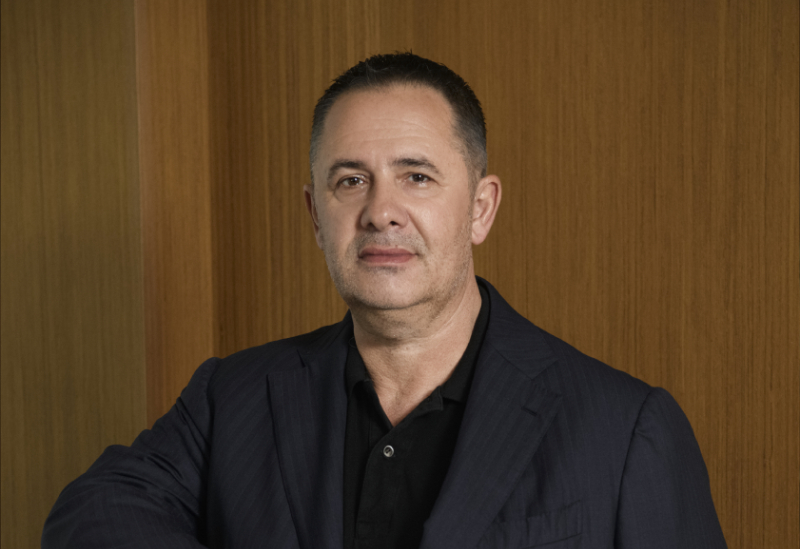
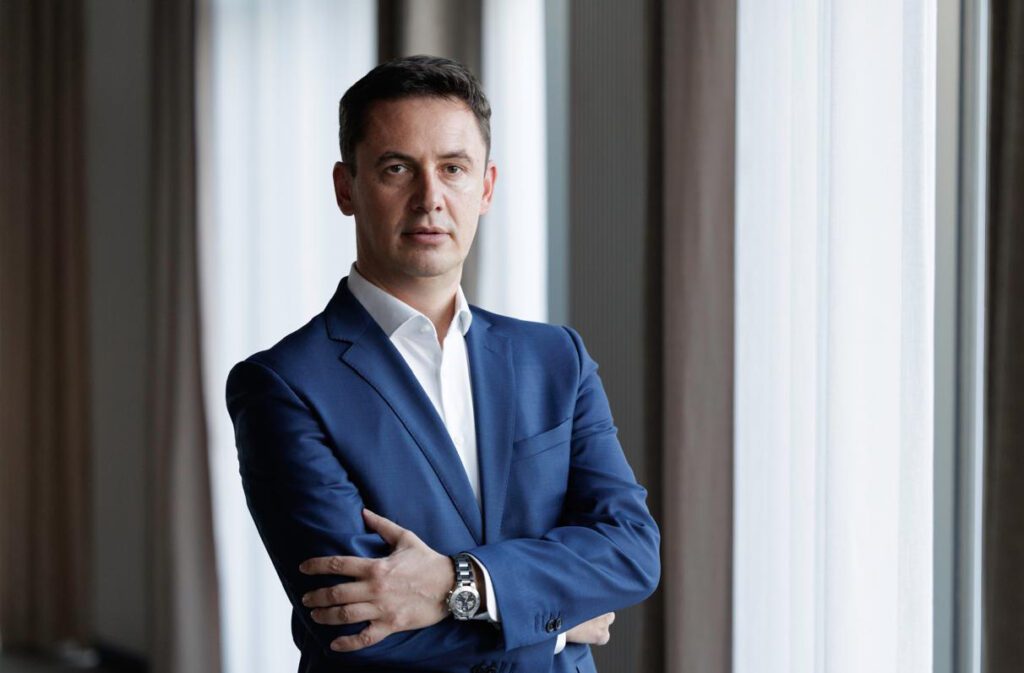
Juljan Mane- Vice President Retail, BALFIN Group
As recently reflected in the media, Juljan Mane shared a clear outlook for 2026: retail is expected to continue on a stable growth path, with tourism remaining a key factor shaping demand and category mix. The main message is that future growth will rely less on pure volume and more on quality, customer experience and operational efficiency.
Juljan Mane shares a comprehensive view on the performance of the retail sector in Albania and across the region for 2026, focusing on the impact of tourism, changing consumer behaviour, cost pressures and informality, as well as BALFIN Group’s strategic priorities, from market consolidation and strengthening existing networks to expansion beyond the Western Balkans and omnichannel transformation.
How do you see the outlook for the retail sector in Albania and the region in 2026?
In 2026, we expect a continuation of the growth trend seen in 2025, a normal and sustainable growth path, without major structural shifts in consumption.
In Albania, tourism continues to be one of the main growth drivers. The increase in tourist flows is generating higher sales volumes not only in daily consumption categories, but also in fashion, souvenirs, light electronics and leisure-related services. Across the region, the dynamics remain similar: relatively small markets with price-sensitive consumers, who are nevertheless increasingly demanding higher standards, better quality and a stronger in-store experience.
Assuming there are no major external shocks, such as energy disruptions, supply chain issues or geopolitical developments, 2026 is expected to be a stable year, where competition will be driven more by operational efficiency, service quality and well-structured offerings, rather than by a demand boom.
From a group perspective, we remain confident in the market outlook, as modern retail in the region continues to consolidate and improve in quality.
Which retail categories are expected to grow the fastest, and which are more sensitive to changes in consumption?
In the Western Balkans and beyond, price remains a key factor in consumer decision-making. However, the importance of quality and the overall shopping experience is becoming increasingly significant. In this context, the fastest growth in 2026 is expected to come mainly from non-food categories, where consumers more clearly perceive value for money and where product innovation directly stimulates demand.
Consumer electronics and home appliances are expected to perform well, especially in an environment of price stabilization, more competitive offers and faster technological renewal cycles, with new models and improved energy efficiency. Within this category, air conditioners are expected to lead growth, driven by increasingly hot summers and rising demand for higher living standards and comfort.
Another category with strong growth potential is affordable fashion, where the combination of quality, controlled pricing and a broad assortment increases both sales volume and purchase frequency.
On the other hand, the food sector tends to be more stable and less exposed to sharp consumption fluctuations. The formalization process and the gradual shift towards larger, more structured retail networks make the market not only more stable, but also more controlled, particularly in terms of quality, hygiene and consumer trust.
Regardless of category, one of the common challenges across the retail sector remains unfair competition and informality, which directly impact margins, investment capacity and the ability of serious operators to compete on a level playing field.
How is the consumer profile changing, and what are the key shifts in purchasing behaviour?
Today’s consumer is significantly more informed and more comparative than a few years ago. Consumers are looking for price transparency, warranties, after-sales service and a more structured shopping experience, both in-store and online. Purchasing decisions are more considered and less impulsive, particularly in non-essential categories.
In essence, two realities coexist. On one hand, there is a relatively stable segment of consumers oriented towards premium products, where quality, brand and exclusivity play a key role. On the other hand, there is a much broader segment that remains price-sensitive, but not necessarily focused on the cheapest option, instead, these consumers increasingly seek the optimal balance between price and quality.
At the same time, the middle-income segment has become more cautious with spending, planning purchases, comparing options and making decisions based on real value, including quality, durability, warranty and overall experience.
A positive development is the growing presence of international brands and new retail concepts in the local market, reducing the need for consumers to shop abroad. This has increased competition, applied positive pressure on prices in certain categories and, most importantly, raised the overall standard of retail offerings for consumers.
What are your key priorities and planned changes for 2025–2026?
Our main focus for 2025–2026 is sustainable and scalable regional expansion. Individually, markets in the region are relatively small, which makes economies of scale crucial in ensuring efficiency across sourcing, logistics, marketing and technology and ultimately in protecting margins and competitiveness.
This means prioritising brands and concepts that can build volume across multiple countries simultaneously and justify investment in high operational standards.
In practice, this translates into two main directions. First, consolidating and qualitatively strengthening existing retail networks through higher store productivity, service standardisation, staff training, improved inventory management and continued investment in digitalisation to enhance performance and customer experience.
Second, developing partnerships with international brands that bring clear value to consumers and have regional growth potential. Concrete examples include the introduction of brands such as KIABI and Flying Tiger Copenhagen to the region.
At the same time, we are actively exploring opportunities beyond the Western Balkans, in markets where our retail and asset development expertise can be successfully transferred. This expansion will follow a measured and phased approach, based on careful analysis of market potential, partners and locations, ensuring healthy growth and reasonable returns on investment. We have clear plans to enter Moldova in 2026 and are in the final stages of evaluating expansion into Central Asian markets.
How does the growth of online shopping impact your physical retail strategy?
Online sales continue to grow and are expected to do so in the coming years, although growth rates in Albania and the Balkans remain more moderate compared to Western Europe.
The current reality is omnichannel. Customers naturally move between online and physical stores and expect a seamless, simple and consistent experience across both channels.
The physical store remains the core of the customer experience, offering product trial, advice, service and trust, while increasingly taking on a functional role as a fulfilment point for orders, returns, exchanges and click & collect.
This drives parallel investment in both in-store experience and technology, including integrated inventory, CRM systems, payments, analytics and customer service, ensuring readiness across all channels.
In certain categories, such as fashion, online has a stronger impact. In others, where physical interaction with the product and service quality are decisive, brick-and-mortar stores continue to dominate. The fact that shopping centres are maintaining and in many cases increasing, footfall further confirms that consumers in our region continue to highly value physical retail experiences. For us, it is not online versus offline, but two complementary channels that reinforce each other and, when properly integrated, enhance overall business performance.
How do you assess the balance between shopping centre supply and retailer demand? Is there a risk of oversupply?
In general, we do not see a classic oversupply risk, as long as new developments are well thought out in terms of location, concept and tenant mix.
International brands entering new markets almost always seek physical presence in strategic locations to build trust, deliver experience and be part of high-traffic destinations.
Our experience shows that consumers in the region view shopping centres as social destinations, not just places to shop, but also for entertainment, dining and family time. At the same time, new developments are increasingly shifting towards formats such as retail parks, particularly in smaller cities lacking organised retail infrastructure.
What are your expectations regarding rents and operating costs in 2026?
In 2026, we expect continued upward pressure on operating costs, including rent, wages, services, energy, maintenance and logistics. Rents, especially in prime locations, are likely to increase, as demand for quality space remains strong and contracts are often euro-denominated or indexed.
For retailers, the key challenge will be margin protection. In an environment of rising costs, profitability can only be preserved through productivity, effective inventory management, workforce optimisation and technology.
While higher wages increase operating costs, they are positive for society and purchasing power. However, it is essential that this is accompanied by greater formalisation and fair competition, including proper invoicing, correct customs declarations, employment reporting and the elimination of counterfeit goods. Only under these conditions can a healthy market exist where serious investment is rewarded.
What standards do you require from shopping centres to position your brands?
For us, a suitable shopping centre is more than just leasable space, it must function as a destination. We assess several key criteria before placing our brands.
These include location and catchment area, accessibility, road connections, transport, parking and overall convenience for families. We also evaluate stable footfall and customer profile, focusing not only on volume, but also on quality and alignment with brand targets.
Tenant mix is a decisive element, with a balanced combination of strong international brands and complementary concepts across fashion, electronics, food and entertainment. Equally important is the quality of centre management, including operational standards, security, cleanliness, active marketing, events and transparency in reporting. Finally, we look for modern and functional infrastructure that enhances the overall customer experience.
Which regional markets offer the strongest expansion potential?
In the region, markets such as Serbia and Croatia offer real potential due to their size, more developed retail structures and scalability. Croatia, as an EU market, requires higher standards, but this also represents an opportunity for concepts with strong operating models and differentiated offerings.
In parallel, we see potential in new markets where we can introduce innovative retail concepts, always supported by thorough analysis of partners, locations and purchasing power. In 2026, we will be present in Moldova and are planning expansion into Central Asia.
What are the main risks and opportunities for retail over the next two years?
Over the next two years, the retail sector will be influenced by two parallel dynamics: pressure on costs and purchasing power, and clear growth potential driven by market modernisation and tourism.
The main risks relate to rising operating costs, including rent, wages, energy and logistics, which directly pressure margins, particularly for mid-sized operators. Unfair competition and informality remain major challenges, distorting the market and penalising businesses that invest in standards, transparency and proper employment.
Supply chain volatility, high staff turnover and rapidly changing consumer preferences also require agile responses and disciplined management.
On the opportunity side, tourism growth, seasonal consumption expansion, market consolidation and omnichannel transformation stand out. The integration of physical stores with digital channels, unified inventory, faster service, easier returns and personalised communication will be key competitive advantages.
Ultimately, the winners will be retailers that build their offer around value for money, continuously improve in-store experience and leverage technology to become more efficient, responsive and closer to the customer.