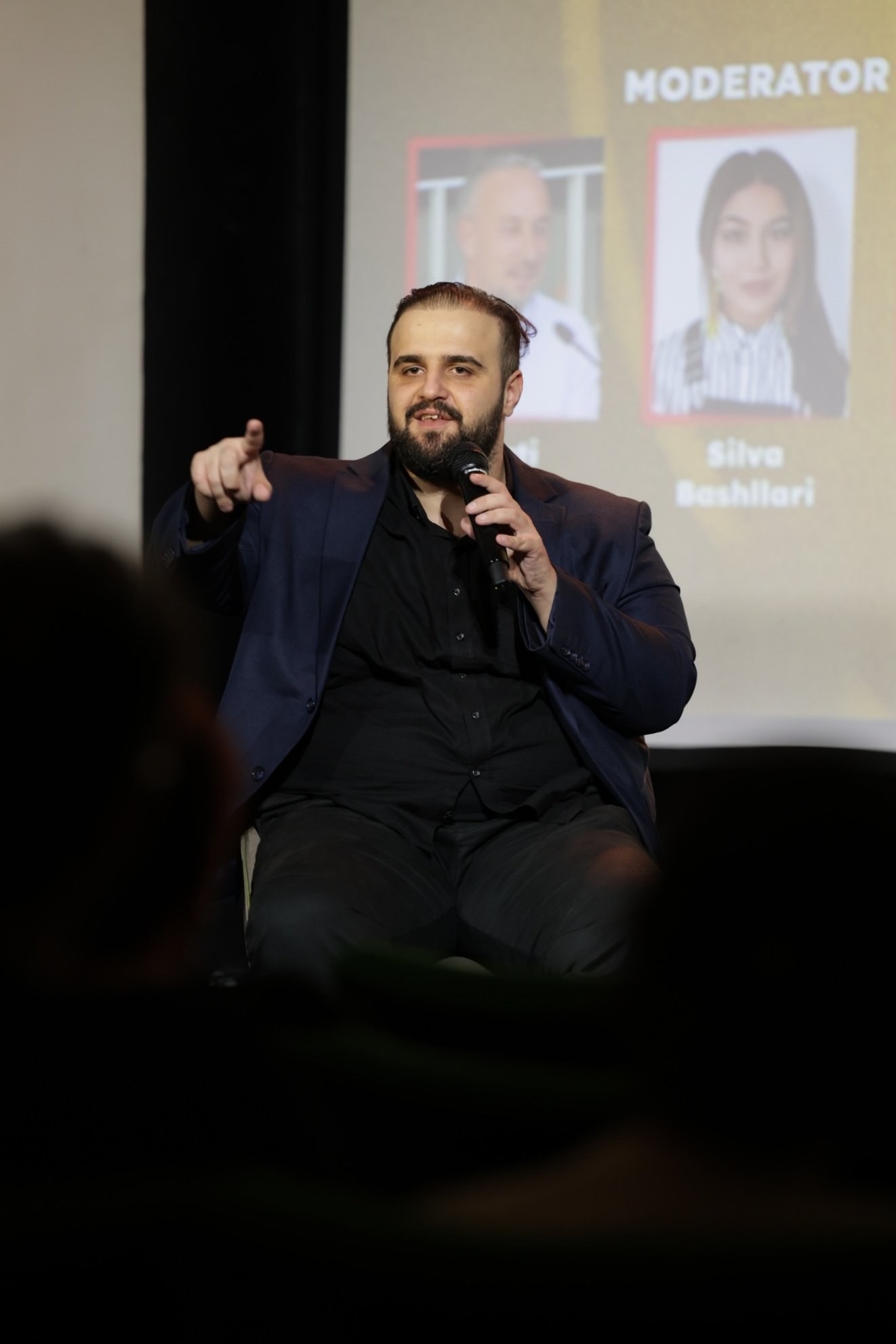
For the first time, Tirana International Film Festival (TIFF) brought together industry experts and professionals to discuss artificial intelligence and its impact on film production and the future of cinema. Among the guests was Marlind Maksuti, Head of the Software Development Team at BALFIN Group. He noted that we are entering an era where the creative process is becoming easier for creators, allowing them to be even more original.
From September 22 to 28, TIFF held its 22nd edition. As one of the most important cinematic events in Albania, this year’s festival presented over 200 films in the capital’s theaters, many of which were premieres. TIFF 2024 also dedicated an entire day to exploring the impact of artificial intelligence on the film industry.
TIFF gathered industry experts and professionals to discuss tools that boost AI’s creative potential and how artists should approach this technology. Marlind Maksuti, Head of the Software Development Team at BALFIN Group, delved into advanced AI techniques, explained how diffusion models work, and discussed their significance in enhancing creativity and efficiency in various creative processes. He stated: “We are entering an era where the creative process is becoming easier for creators, giving them the advantage of being even more original.”
What are diffusion models?
Diffusion models simulate a process where noise is gradually reduced. The image is dismantled and then reconstructed, allowing AI to learn complex patterns and generate new content from random noise. These models create images through a series of steps, training the AI to transform noise into coherent images, thus pushing the boundaries of creativity in audiovisual media.
Maksuti noted that, thanks to these models, conceptual art can be generated much more quickly with just a button press; cinematic scenes are significantly improved, and, above all, the visual narrative is communicated seamlessly.
He emphasized that the ethics of artificial intelligence depend on how it is used, saying, “AI is here to help, not to replace.”
“Artificial intelligence acts as a creative partner, helping artists explore new possibilities and push the limits of what they can achieve while keeping their unique style. Instead of seeing AI as competition, artists should view it as an opportunity that opens doors to new workflows, allowing them to focus more on the creative process rather than technical challenges,” concluded the Head of the Software Development Team at BALFIN Group.